King & Sendak’s “Hansel and Gretel”

Like most students learning a language, I took your usual school language classes. I learned to conjugate verbs and studied lists of vocabulary. I didn’t think I would ever learn to actually speak and hold conversation until one class changed everything. I signed up for a Grimms’ fairytales class in German. An entire class reading fairytales. This class changed my language journey, instead of trying to translate word for word, I started reading. I started learning meaning of words through context. The same way I read in English, I was learning to read in German. It was in that class that I truly realized the importance of stories and how we learn from them. This was of course two-fold, including both the lessons the Grimms fairytales taught and the way we read and hear stories teaching us language, imagination, and new perspectives.

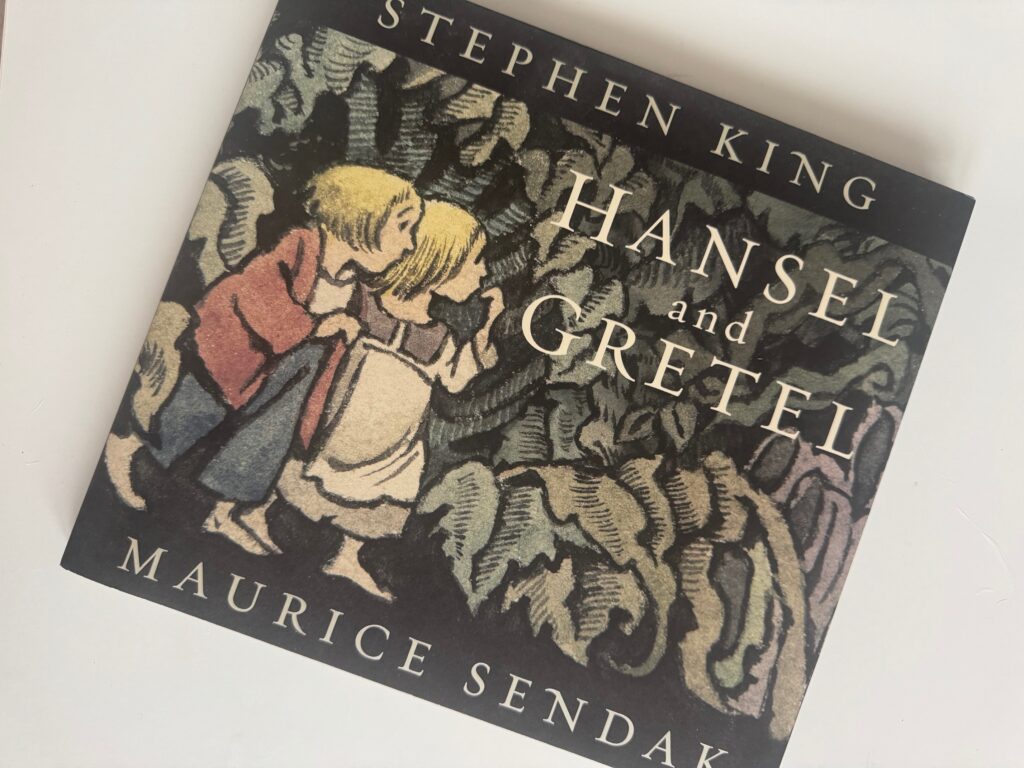
Those stories have stayed with me. I love the original versions (far darker than the ones we tend to read today), retellings, picture book versions. When I saw the Stephen King retelling of “Hansel and Gretel” illustrated by Maurice Sendak, I needed to read that version.

For those of you who have been long time readers of on the children’s shelf, you may remember my Maurice Sendak story. For those who are newer here, many years ago, I was sitting in a waiting room and Maurice Sendak walked in. He sat down and immediately opened a book which he held up so no one would notice him; except I already had. I was trying to keep my cool, but he realized I recognized him. He lowered his book, made eye contact with me and smiled. It’s not a dramatically exciting story but it means so much to me. In that moment, I hope my excitement expressed my gratitude for his stories, appreciation of his illustrations, and that I truly believe great children’s stories impact us for the rest of our lives.

King and Sendak’s “Hansel and Gretel” is a beautiful retelling. The illustrations are everything I hoped they would be and more. This retelling brings a combination of the Grimm brothers and King into a dark and magical new tale with proper homage paid to the original story.

When you pick up your copy, be sure to remove the dustjacket…the book itself is beautiful. Definitely check out this incredible retelling of famous fairytale.

Loading

The Grimm Fairytale Hidden for 150 Years

“Dear Mili” by Wilhelm Grimm existed only in a letter for over 150 years. The letter containing the story was sent to a young girl in 1816. Her family kept the letter for over 150 years before sharing it with the world. The discovery of this unknown Grimm fairytale in 1983 made the front page of the NY Times. It was published and illustrated by Maurice Sendak.

I grew up reading the Grimm fairytales…the versions we know today with happy endings. Cinderella falls in love with the Prince and leaves her wicked stepmother. Hansel and Gretel push the wicked witch into the oven and escape her candy house. Each tale has an element of fear of what could go wrong, but they all ended with the positive outcome. When I studied at Univeristy, I took a class reading Grimm fairytales in the original German. Those tales were darker and didn’t have the neat clean happy ending. They were incredible tales, but they definitely taught lessons…stay out of the woods, don’t talk to strangers…because something really bad can happen.

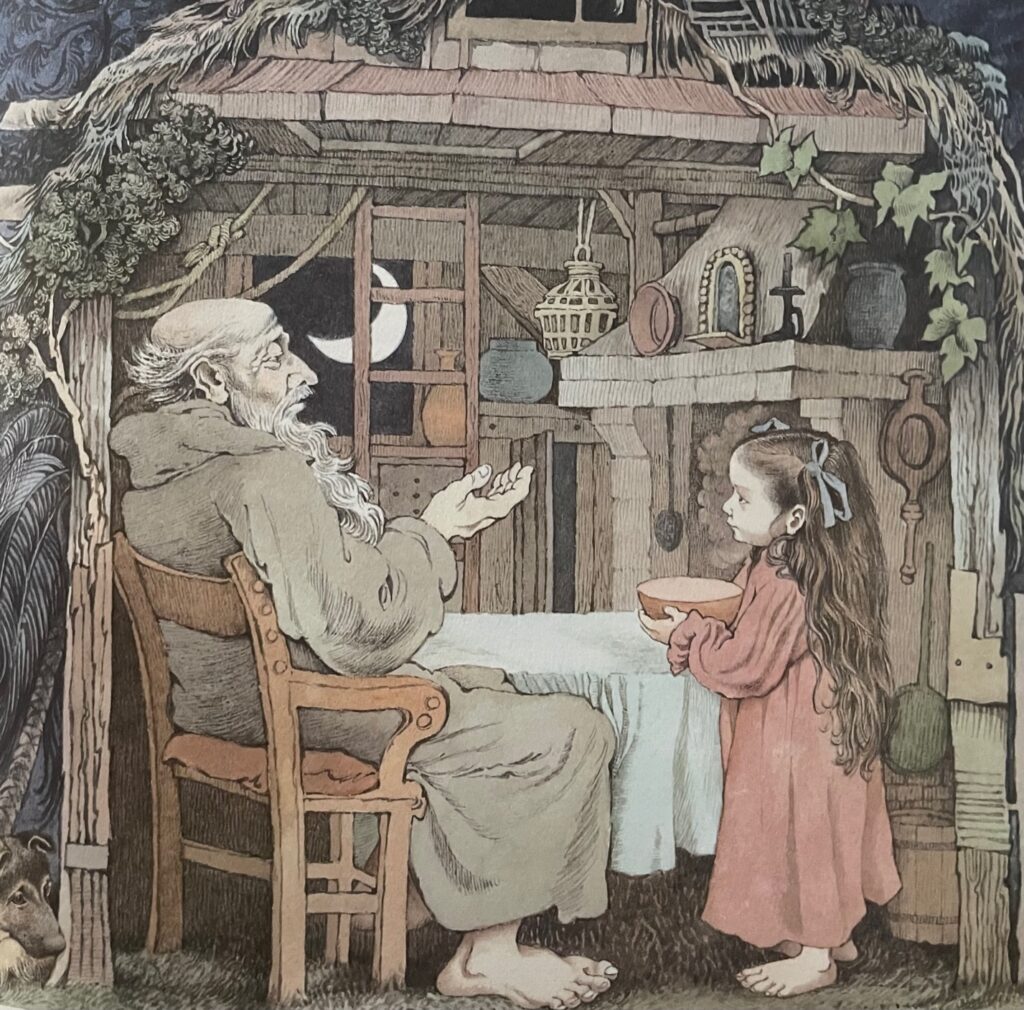
I recently found a copy of “Dear Mili” and was excited to read this beautifully illustrated, hidden for over 150 years, tale. The story begins with a mother sending her only child into the woods to hide when a war breaks out. She gives her food and tells her to go deep into the woods and return in 3 days. The child does as she is told. As she travels far into the woods, she meets an old man who lives in a hut who offers her food and shelter. She accepts and in exchange, looks for root vegetables for their meals. While searching for roots, she meets a young girl, who looks just like her, who helps her find the roots and is believed to be her guardian angel. After 3 days pass, the old man tells the young girl that she must return to her mother and the guardian angel child leads her back to the village.

The little girl is sad to leave the old man, but he gives her a rose and tells her when it blooms, they will be together again. As the little girl arrives back in the village, she notices how different everything looks. How could things change so much in 3 days? She sees her mother, but she appears much older. Her mother is thrilled to see her, as the little girl has been gone in the woods for 30 years not 3 days. The mother is very old and dying and her one wish was to see her child one more time before she died.

The next morning, the rose blooms. Read this tale to find out what happens when the rose blooms.

While the beautiful illustrations make this book appear to be a story for readers of all ages, I would take the individual reader’s personality into consideration before reading this tale to them. It is incredible but it is dark and far darker than the Disney version of Grimm fairytales we are used to. Not gory but it is a traditional Grimm twisted tale. I finished the book, put it down and just said “wow” while processing it. Definitely worth reading but should be read by an adult in the family first to see if appropriate for your specific young reader.

I wonder if there are any other Grimm fairytales sitting in letters in someone’s attic.