Like most students learning a language, I took your usual school language classes. I learned to conjugate verbs and studied lists of vocabulary. I didn’t think I would ever learn to actually speak and hold conversation until one class changed everything. I signed up for a Grimms’ fairytales class in German. An entire class reading fairytales. This class changed my language journey, instead of trying to translate word for word, I started reading. I started learning meaning of words through context. The same way I read in English, I was learning to read in German. It was in that class that I truly realized the importance of stories and how we learn from them. This was of course two-fold, including both the lessons the Grimms fairytales taught and the way we read and hear stories teaching us language, imagination, and new perspectives.
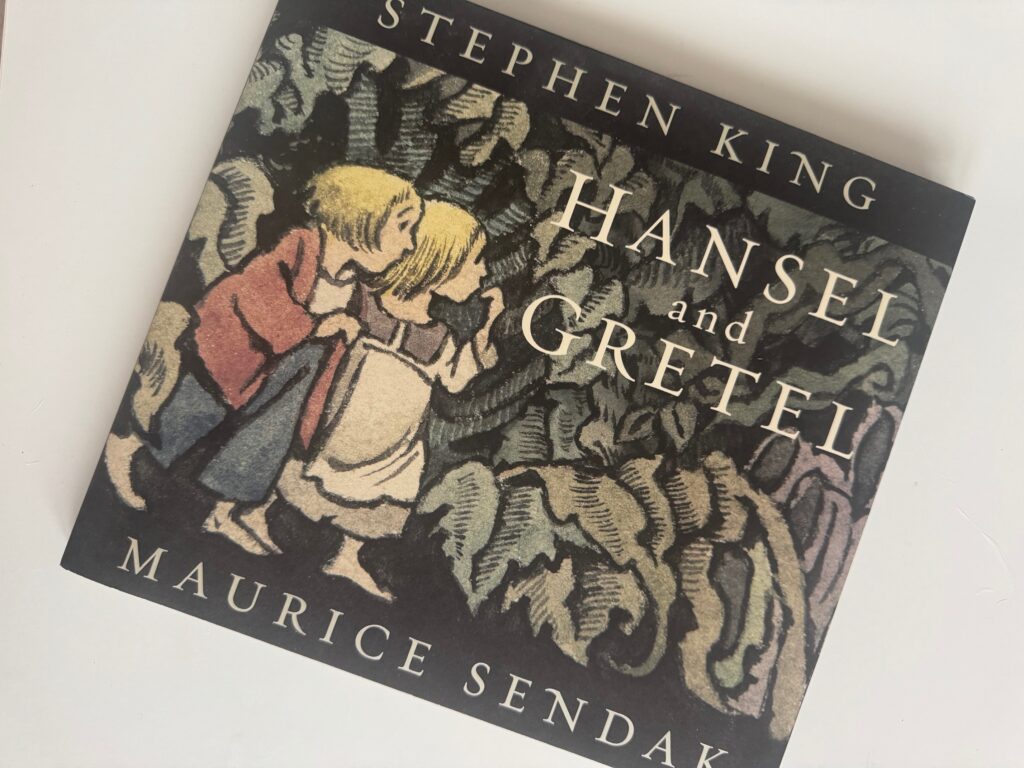
Those stories have stayed with me. I love the original versions (far darker than the ones we tend to read today), retellings, picture book versions. When I saw the Stephen King retelling of “Hansel and Gretel” illustrated by Maurice Sendak, I needed to read that version.
For those of you who have been long time readers of on the children’s shelf, you may remember my Maurice Sendak story. For those who are newer here, many years ago, I was sitting in a waiting room and Maurice Sendak walked in. He sat down and immediately opened a book which he held up so no one would notice him; except I already had. I was trying to keep my cool, but he realized I recognized him. He lowered his book, made eye contact with me and smiled. It’s not a dramatically exciting story but it means so much to me. In that moment, I hope my excitement expressed my gratitude for his stories, appreciation of his illustrations, and that I truly believe great children’s stories impact us for the rest of our lives.
King and Sendak’s “Hansel and Gretel” is a beautiful retelling. The illustrations are everything I hoped they would be and more. This retelling brings a combination of the Grimm brothers and King into a dark and magical new tale with proper homage paid to the original story.
When you pick up your copy, be sure to remove the dustjacket…the book itself is beautiful. Definitely check out this incredible retelling of famous fairytale.